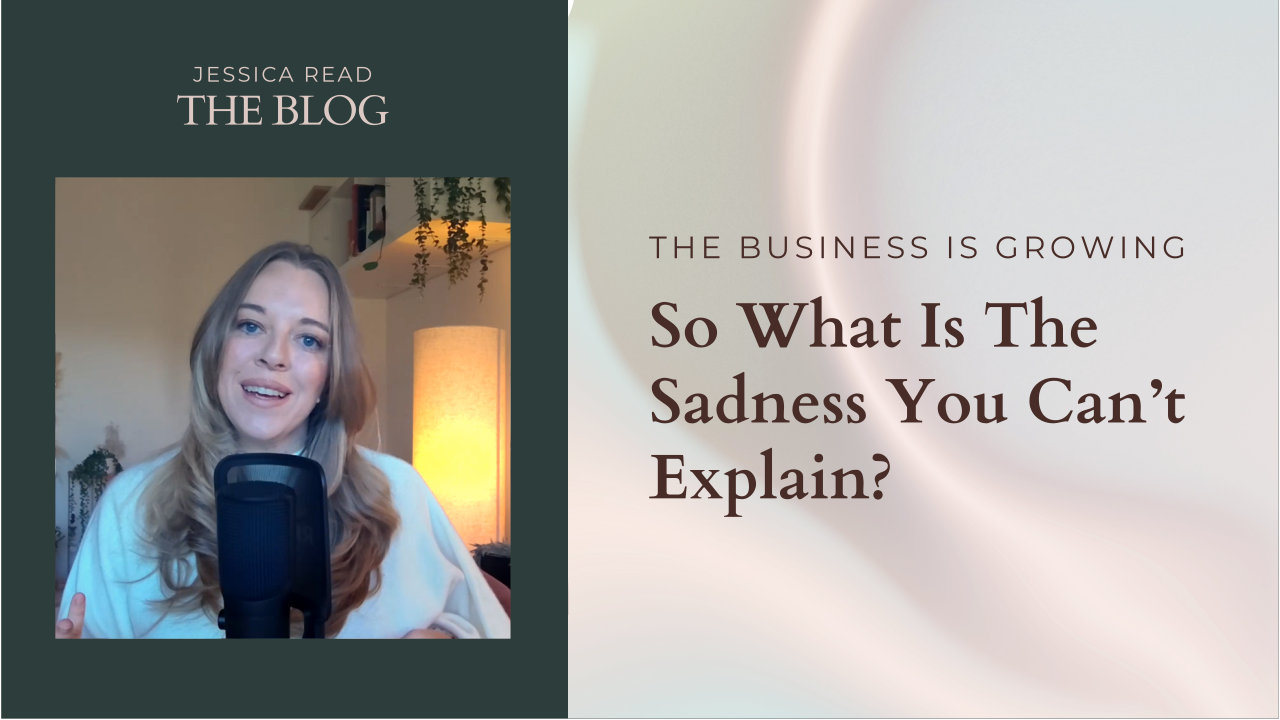
Identity Shift for Women Entrepreneurs: The Grief Nobody in Business Talks About
LISTEN HERE | WATCH HERE
Identity Shift for Women Entrepreneurs: The Grief Nobody in Business Talks About
Identity shift for women entrepreneurs is one of those phrases that gets thrown around a lot in the online business world. We talk about becoming the next-level version of yourself. We talk about nervous system capacity and embodied leadership and building the business that matches who you're becoming.
What we almost never talk about is what it actually feels like to leave the old version behind.
Because it doesn't just feel like growth. Sometimes it feels like grief.
The sadness that arrives right before a move you know is strategically right. The flatness after the goal you chased for years. The resistance to delegation that should feel like relief. The weight of building something leveraged when every part of you is still attached to the intimacy of what you built with your hands.
If you have ever experienced any of that and called it resistance, or self-sabotage, or just decided you weren't ready yet, this is for you.
When Identity Loss in Business Actually Shows Up
This grief is not random. It tends to arrive at very specific moments in a growing business, and recognising them is the first step to understanding what's actually happening.
The move from one-to-one to leveraged. If you have been building a career on deep, intimate client work and you know you need to scale, you have probably experienced the stall. Every time you go to build the group program or the membership, something stops you. The stories you tell yourself are strategic: the timing isn't right, the messaging needs more work, the market isn't ready. But underneath those stories, if you get really honest, it feels like betrayal. Like you are abandoning the intimacy that made your work feel like yours.
Building a team. Delegation is supposed to feel like freedom. For a lot of women, it feels like something is being taken from the work rather than added to it.

Hitting a long-held goal and feeling nothing. Or feeling sad. This is one of the most disorienting experiences in business because it makes no logical sense. You achieved what you said you wanted. Instead there is this flatness, this quiet, this faint sense of mourning for something you cannot quite name.
The transition from doing to leading. When your business grows past the point where you can have your hands on everything, there is a particular grief in that shift. The distance between you and the work that used to feel like the whole point.
Visibility expansion. Being asked to be known at a bigger scale. And something in you keeps pulling back toward the version of this where it was smaller and closer and safer.
None of these are strategic failures. They are signals that something real is happening at the identity level. And once you understand what that something is, the grief stops feeling like dysfunction.
What Resource Therapy Reveals About Business Growth and Identity
Resource Therapy is a modality that works with parts of the personality. Not as a metaphor. Literally. Distinct states within us that developed at different points in our lives in response to what we needed to survive, to be loved, to be enough.
Some of those parts are what Resource Therapy calls Resource States. These are the parts of you that are grounded, present, creative, genuinely you. The parts that lead from fullness.
And some are Survival States. A Survival State is a part that developed as a protective response to an environment that required something specific from you. She is not broken. She is not a problem to be fixed. She is brilliant. She built a strategy with exactly what was available to her, and that strategy worked.
The specific Survival State that drives most high-achieving women's businesses is the indispensable one. The part who learned that her worth lived in being needed. In being present across every client relationship, every room, every decision. The one who held it all together.
She may have developed this strategy long before the business existed. Being capable was how she received love. Being the one who held it together was how she stayed safe. She carried that strategy all the way into her work, and it worked remarkably well.
And now growth is asking her to step back. To delegate, to build a model that doesn't require her in every room, to lead from a different place entirely. And her system is reading that as a threat. Not as an exciting strategic pivot. As a threat to her entire existence.
So she grips. She creates the resistance, the stalling, the unexplained heaviness that shows up every time you try to make the move. Not because she is intentionally sabotaging you. Because she is doing exactly what she was built to do. Protecting you.
Why You Cannot Strategy Your Way Through This
Here is the problem with calling this resistance or self-sabotage: those labels send you looking for a strategic solution to a grief problem. You hire another coach. You restructure the offer. You build a new funnel. And the heaviness remains.
The Survival State does not respond to better strategy. She responds to being seen. To being felt. To being honoured for everything she has done and then, gently, given permission to rest.

That is what grief actually looks like in this context. Not a ceremony. Not weeks of processing. The permission to feel the loss without making it mean something has gone wrong. The permission to say: this part of me was real, she mattered, and I am allowed to mourn her. I can feel this in my body and still move forward.
She built your business. She deserves more than a mindset hack.
Grief is not the opposite of growth. It is the doorway. You do not bypass it and arrive somewhere better. You move through it and arrive somewhere truer.
The bypass is what keeps women cycling through the same ceiling, the same stall, the same wondering why the strategy is not working. The strategy was never the problem.
Growth Is Asking You to Become More of Who You've Always Been
This is the part that the fear obscures. The woman on the other side of this identity shift is not who you are afraid she is.
She is not the version of you who works 60-hour weeks and stops feeling things. She is not the kind of leader you used to judge. She is not a stranger.
The Survival State was never showing you who you were. She was showing you who you needed to be to stay safe. The doing, the holding, the indispensability: that was the strategy. Not your true self.
Underneath the Survival State, in Resource Therapy terms, is a Resource State. The actual you. The one who existed before the protective strategy was necessary. Creating from genuine desire, not from fear of what happens if you stop. Leading from presence, not from performance. Holding a larger business, a team, a bigger container, and still feeling like yourself. More like yourself than you have been in years.
The intimacy of your work does not disappear when you scale. It moves. It lives in different places. The soul of what you have built does not leave. It expands. The connection with clients becomes something you choose rather than something you need.
Identity shift for women entrepreneurs at this level is not about becoming someone new. It is about integrating more of who you have always been. Growth is bringing you home to yourself, without the armour. That is not loss. That is the most fully yourself you have probably ever been.
Your Next Step
If this landed, the Empire Edge Diagnostic is free, takes under five minutes, and will give you a clear picture of what is happening across your business, your identity, and your nervous system, with the exact lever to pull to break through your current ceiling.
And if you want to hear this conversation in full, Episode 209 of The Fck Yes Frequency covers the complete Survival State framework, the grief process, and the Resource State underneath.